

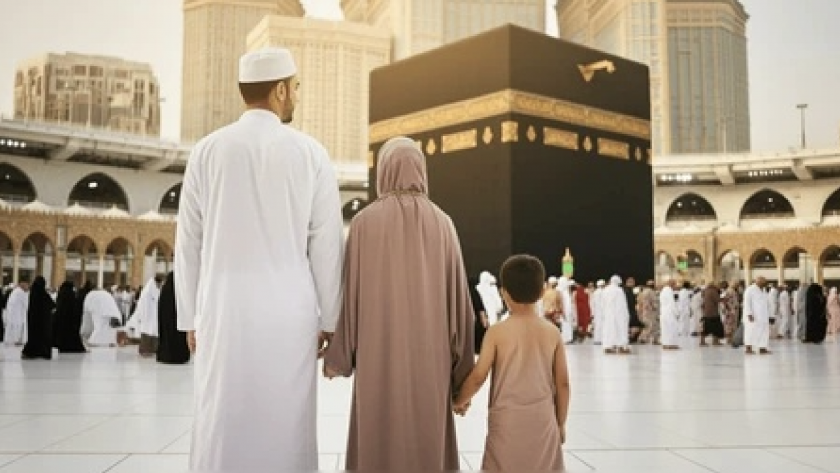
For many Muslim parents in the UK and the US, the idea of Umrah with young children begins with a quiet hope rather than a confident plan. As a parent you are excited for sure as your lovely kid is joining you on this journey for the first sight of Kaaba.
You imagine your child seeing the Kaaba for the first time, the excitement is real. You imagine them copying your movements in prayer, asking simple questions, holding your hand as you walk toward the Haram. You hope that even if they do not understand everything, something settles in their heart early.
- Almost immediately, worry follows.
- Will they cope with the crowds?
- Will they cry during tawaf?
- Will I disturb other people’s worship?
- Will I be so busy watching them that I forget why I came?
This guide is written for those parents.
Umrah with children is about intention, not perfection
There is no single right age to take children for Umrah and preparing your heart for Umrah, it’s actually the spiritual preparation. Some children adapt easily at a young age. Others struggle even when they are older. Readiness depends far more on temperament, health, and stamina than on numbers.
Islamically, a child’s Umrah is rewarded, but it is not obligatory. This changes how parents should approach the journey. The goal is not to complete every ritual exactly as planned. The goal here is exposure, intention, and presence. Parents who experience the most stress are often those who expect their children to perform Umrah the way adults do. Parents who allow flexibility tend to leave with calmer hearts and better memories. Umrah with young children works best when parents plan for pauses, rest, and emotional regulation rather than pushing through exhaustion.
The emotional pressure parents feel inside the Haram
One of the hardest parts of Umrah with kids is not physical. It is emotional. Parents worry constantly about disturbing others. They rush their children. They lower their voices. They apologise silently for normal behaviour.
- A toddler whining.
- A child asking questions loudly.
- A stroller slowing movement.
This constant self-awareness drains energy quickly. Parents feel torn between wanting their child to experience the Haram and wanting to be invisible. It helps to remember that children have always been part of the Haram. Their presence is not new and it is not wrong. Worship has always existed alongside families.
When parents accept that Umrah with children will look different, the experience becomes lighter. Worship does not disappear because a child needs attention. It simply takes a different shape.
Understanding Umrah with kids stroller rules in real life
Search trends show that queries around Umrah with kids stroller rules are rising steadily, especially among UK and US parents. This is because stroller use at the Haram is confusing in practice. There is no single rule that applies at all times. Stroller access depends on crowd levels, timing, and location. During peak prayer times, movement can become extremely difficult. During quieter hours, especially late at night or very early in the morning, it is far more manageable.
Upper levels are often calmer for families, but reaching them requires planning. Some entrances work better with strollers than others. Parents who arrive without knowing this often feel overwhelmed very quickly. Trying to figure this out while already tired and responsible for children is one of the most stressful parts of Umrah with kids. Families who plan their tawaf around quieter windows usually report a far calmer experience.
How children experience rituals differently
Children do not experience Umrah the way adults do. They do not understand why tawaf takes so long. They do not feel the same urgency. Their bodies tire faster and their patience runs out sooner. Parents who manage Umrah with children successfully often shorten expectations rather than rituals. They pause. They step aside. They break tawaf into segments if needed. Small things make a big difference. Familiar snacks. Water breaks. Comfortable clothing. Shoes that are easy to remove. Explaining what is happening in simple language. Children may not remember every ritual. They remember how they felt while doing them.
The hidden impact of hunger, sleep, and overstimulation
Many parents underestimate how strongly hunger and tiredness affect children during Umrah. Excitement and noise can suppress appetite for hours, followed suddenly by emotional collapse. Sleep disruption from time zones, late nights, and early prayers affects children far more than adults.
Overtired children become restless, clingy, or withdrawn. Parents often mistake this for misbehaviour when it is simply exhaustion. Building rest into the journey matters. Returning to the hotel for naps, even if it means missing a prayer in congregation, often leads to better focus later. Worship improves when children are regulated.
The sensory environment of the Haram can also overwhelm children. Bright lights, constant movement, and physical closeness are a lot to process. Some children become hyperactive. Others shut down. Stepping aside, finding quieter corners, or simply allowing children to observe rather than participate actively can help them settle.
Why hotel choice matters more for families than most expect
For families, the hotel is not just a place to sleep. It is a recovery space. Parents without children can tolerate long walks and difficult access. Families often cannot. When children are tired or overstimulated, the ability to return to the room quickly becomes essential. Hotels that look close on a map can still require exhausting walks. Parents rush. Children resist. Tempers shorten.
Zamzam verifies hotel proximity based on real walking routes, not distance claims. For families with children, this usually means hotels within five to ten minutes of manageable walking, allowing quick returns for rest, feeding, or calming a child. Adjoining rooms, reliable lifts, and safe surroundings are not luxuries for families. They are what make Umrah with children possible.
Ground transport shapes the first impression of Umrah
Arrival is often the most stressful moment for parents. Children are tired. Parents are carrying bags, strollers, sometimes car seats. A standard vehicle arrangement that works for adults often does not work for families. Space matters. Ease matters. Knowing the driver understands you are travelling with children matters. Many parents describe arrival transport as the moment when anxiety peaks. When this part goes smoothly, stress drops immediately.
Zamzam’s ground transport accommodates strollers and provides family friendly vehicles so families arrive feeling settled rather than scattered.
Managing prayer with young children spiritual preparation
Prayer in the Haram with young children requires a different kind of patience, and for many parents doing Umrah with children, this is where expectations quietly shift.
Parents often arrive imagining they will pray the way they always have. Long qiyam. Stillness. Focus. In reality, prayer during Umrah with kids looks different. Sometimes one parent prays while the other steps aside with a restless child. Sometimes you find a quieter corner rather than joining the densest rows. Sometimes you begin a prayer knowing you may have to leave before it ends.
None of this reduces the value of worship. Parenthood changes how worship is expressed. It does not diminish it. When you shorten a prayer to soothe your child, or step back so others are not disturbed, that care is part of your worship. Many parents only realise this later, after feeling unnecessary guilt in the moment.
Explaining the sacredness of the space to children in simple, gentle words helps more than strict instructions. Standing together for a few moments. Holding hands. Whispering what is happening. Letting them watch quietly even if they cannot stay long.
During Umrah with young children, these small moments often carry more meaning than completing every prayer in congregation. Children absorb the atmosphere of the Haram even when they are not standing beside you for long. They notice the calm in your voice, the respect in your movements, and the way you respond when things do not go perfectly.
For parents worried that Umrah with kids means missing out spiritually, this is often the most reassuring realization. Worship does not disappear. It simply takes a form that includes care, patience, and presence.
Safety concerns every parent carries quietly
Crowds heighten parental anxiety in ways many parents do not fully anticipate until they are standing inside the Haram with a child’s hand in theirs. Even parents who rarely worry at home find themselves scanning constantly, counting heads, checking grips, replaying small “what if” scenarios in their minds. This is not fear. It is my responsibility. And it can quietly drain emotional energy if it is not acknowledged.
Simple precautions create a sense of control that allows parents to breathe again. Something as small as an ID wristband with contact details can make a difference, not because you expect to need it, but because it removes the constant background worry. Agreeing on clear meeting points with older children, repeating them calmly, and teaching children what to do if they cannot see you helps both parent and child feel more secure.
Safety continues back at the hotel, where children finally relax. Parents often forget to pause and check the room properly because they are tired. Door locks, balconies, furniture placement, and room layout matter more than aesthetics when you have young children. A room that feels safe allows parents to sleep more deeply and start each day with more patience.
These precautions are not about being anxious or overprotective. They are about creating enough safety that vigilance can soften. When parents are not constantly on edge, they can focus on worship instead of scanning crowds, counting minutes, and preparing for problems that may never happen.
That shift from constant alertness to quiet presence is what many parents later describe as the difference between merely completing Umrah with children and truly experiencing it.
What UK and US parents often say afterward
Taking children for Umrah is rarely neat or predictable. It is not about creating perfect moments or collecting memories that look good from the outside. It is about showing up, day after day, with intention, even when you are tired, even when things do not unfold the way you imagined.
It is about your child standing beside you for a few quiet moments of prayer, listening to du‘a even if they do not understand every word, sensing the atmosphere of the Haram, and watching how you carry yourself when the day becomes difficult. Children learn far more from how we respond than from what we explain. There will be moments when your child needs you more than the prayer you hoped to finish. Moments when you step aside, shorten a ritual, or leave earlier than planned. It is easy to feel disappointment in those moments, but they do not take away from the journey. They are part of it.
What stays with children is not how many prayers you completed or how long you stayed. It is how safe they felt beside you. How calmly you spoke. How gently you guided them through unfamiliar spaces. How you showed patience when you were stretched. With thoughtful planning and the right support, Umrah with young children can become a deeply meaningful experience for both parents and children. Not because it is easy, but because it teaches presence, patience, and trust in a way few journeys do.
You bring your intention, your love, and your responsibility as a parent. Zamzam takes care of the ground journey quietly and reliably, so you can give your attention to what truly matters, being present with your family in a place that will stay with them for years to come.
How Zamzam supports families on Umrah
Zamzam identifies family groups with children early and plans around that reality. Hotels are suggested with quick rest returns in mind. Ground transport accommodates strollers and family needs. On ground support understands that families need patience and clarity, not rushed solutions.
The Journey Companion provides family friendly navigation and crowd awareness, helping parents plan timings and avoid unnecessary pressure points. This support does not remove parenting challenges. It removes isolation.
A final reflection for parents
Taking children for Umrah is not about creating perfect moments you can replay later. It is about being present while things unfold as they will.
It is about your child standing beside you for a few moments of prayer, hearing du‘a even if they do not understand every word, sensing the calm and seriousness of the Haram, and watching how you respond when the day does not go as planned. Some moments will feel rushed. Some prayers will be shorter than you hoped. Some days will be harder than others. That does not take away from the journey. It is part of it.
What stays with children is not how much you completed, but how it felt to be there with you. The patience you showed. The gentleness in your voice. The way you kept going without panic when things became difficult. With thoughtful planning and the right support, Umrah with young children can be deeply meaningful, not despite the challenges, but because of them. You bring your intention, your love, and your responsibility as a parent. Zamzam quietly takes care of the ground journey, so you can focus on what truly matters.
