

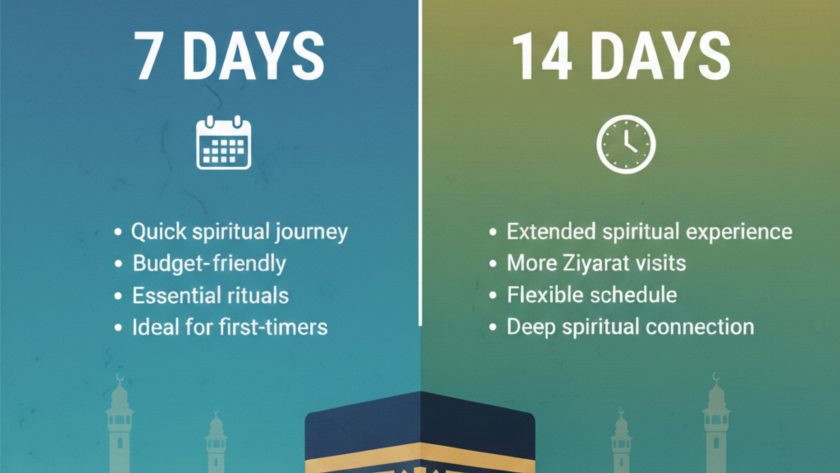
If you are comparing a 7 days Umrah package with a longer stay, you are already asking the right question. The length of your Umrah trip affects almost everything: cost, pace, physical strain, spiritual focus, and how calm or rushed the experience feels upon arrival.
Many UK pilgrims start by searching for a 7 days Umrah package from UK because it feels manageable. Time off work is limited, flights are expensive, and the idea of being away for two weeks can feel overwhelming. Others, especially families or first-time pilgrims, worry that seven days will feel rushed and leave little room to rest or reflect.
This guide compares 7-day and 14-day Umrah itineraries in practical terms. It explains who each option suits best, what a realistic day-by-day plan looks like, how costs change, and how to decide which length fits your situation. The goal is not to push one option over the other, but to help you choose confidently.
Choose 7 days if: limited annual leave, repeat pilgrim, travelling as a couple, you want “Umrah-first” with minimal extras.
Choose 14 days if: first Umrah, travelling with elderly/children, you want rest days + ziyarat, or you want a calm pace.
Best planning rule: the shorter the trip, the more you must prioritise walkable hotels and reliable transfers.
Whichever length you choose, Zamzam keeps the on-ground plan calm with flexible hotels near Haram and pre-arranged transport.
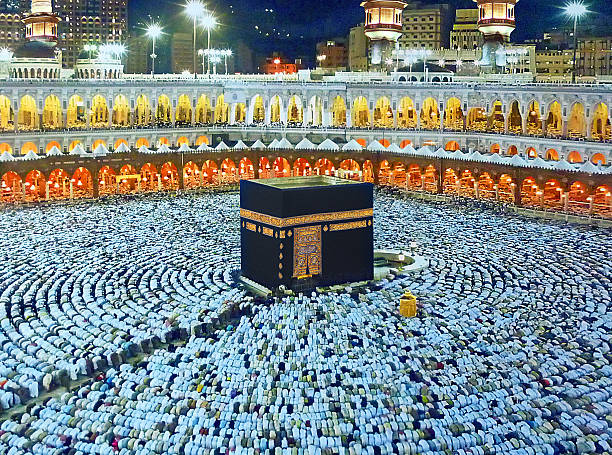
At a Glance: 7-Day vs 14-Day Umrah Comparison
| Feature | 7-Day Umrah | 14-Day Umrah |
|---|---|---|
| Best for | Professionals, young couples, repeat pilgrims | First-timers, families, elderly parents |
| Pace | Focused, efficient | Relaxed, flexible |
| Physical demand | Higher | Lower |
| Cost driver | Fewer hotel nights | More hotel nights |
| Ziyarat time | Limited | Ample |
| Risk of fatigue | Higher if poorly planned | Lower |
| Flexibility | Limited | High |
Planning from the UK & US (airports + school holidays)
If you’re travelling from the UK or the US, the same itinerary can feel completely different depending on flight timing, peak weeks, and how close your hotel is to the Haram.
Common departure airports to plan around (with codes):
- UK: London Heathrow Airport (LHR), Manchester Airport (MAN)
- US: John F. Kennedy International Airport (JFK), Washington Dulles International Airport (IAD), Los Angeles International Airport (LAX)
When prices spike (and 7 days start feeling “tight”):
- UK: Half-terms (Oct, Feb, May), Easter, summer holidays
- US: Spring Break, Thanksgiving week, winter holidays
Simple rule: if you’re travelling in peak weeks, protect your energy. That usually means more walkable hotels and pre-arranged transport, so your short stay doesn’t get eaten by fatigue and taxi stress.
Zamzam accommodates both 7-day and 14-day stays with verified hotels near the Haram and ground transport inside Saudi Arabia, so your itinerary stays calm even during peak weeks.
Who a 7 Days Umrah Package Is Best For
A 7 days Umrah package suits pilgrims who are comfortable with a focused itinerary and limited downtime. It is designed for those who want to perform Umrah correctly while working within strict time limits. When planned well, seven days is enough, but it requires clarity, preparation, and realistic expectations.
Professionals With Limited Time Off
Many UK and US pilgrims have limited annual leave. For working professionals, taking two full weeks away is often not possible. A seven-day Umrah allows them to fulfil the journey without extended absence from work or ongoing responsibilities. The trip is compact, purposeful, and easier to fit around existing commitments.
Young Couples Without Dependents
Young couples travelling without children or elderly parents often manage shorter itineraries well. With fewer mobility concerns and more flexibility in daily schedules, couples can move efficiently between prayers, rest, and travel days. For them, an Umrah package for 7 days usually feels organised rather than overwhelming.
Repeat Pilgrims Who Know the Rituals
Pilgrims who have already performed Umrah benefit from familiarity. Knowing how tawaf and sa’i flow, understanding crowd patterns, and recognising the layout of Makkah and Madinah reduces uncertainty. This experience allows repeat pilgrims to focus on worship rather than logistics, making a shorter stay more manageable.
Pilgrims Prioritising Umrah Over Ziyarat
Seven-day trips are best suited to those who want to focus on Umrah itself rather than extended ziyarat. While there may be time for limited visits in Makkah or Madinah, the emphasis remains on completing Umrah and maintaining regular prayers rather than sightseeing or historical tours.
Important Considerations Before Choosing 7 Days
Although seven days can be sufficient, it is not a relaxed option. International travel, jet lag, and long walking distances add physical strain. There is little room for delays, illness, or overpacked schedules. Accommodation distance and transport reliability become especially important.
For pilgrims who understand the pace and physical demands of Umrah, a shorter stay often feels efficient rather than rushed. For others, especially first-timers or families, it may feel tight. The key is choosing a 7-day itinerary intentionally, with a clear understanding of its limits and benefits.
Walkability matters more on a 7-day trip (miles + meters)
On a short itinerary, hotel distance isn’t just “comfort”, it affects how many prayers you realistically make at the Haram without burning out.
A helpful planning range many first-timers aim for is 0.2–0.6 miles (about 300–1,000 meters) from the Haram. Once you’re regularly above 0.8 miles (~1,300 meters), the walk can start feeling long after late prayers, heat, crowds, or if you’re travelling with elderly parents.
If you want genuinely walkable hotels (not “nearby” marketing language), Zamzam verifies proximity and accessibility before you book.
Who Is a 14-Day Umrah Itinerary Better For
A 14-day Umrah itinerary prioritises calm, recovery, and flexibility. It is designed for pilgrims who want time to settle into the journey rather than move through it at a fast pace. While it requires more time away from home, it often leads to a more balanced and less physically demanding experience.
First-Time Pilgrims
For first-time pilgrims, everything about Umrah is new. From navigating Saudi airports to understanding the flow of tawaf and prayer times, there is a learning curve. A longer stay removes the pressure to “get everything right” immediately. If something is missed or needs repeating, there is time to adjust. For many first-timers, fourteen days allows Umrah to feel like a meaningful journey rather than a checklist of tasks.
Families Travelling With Elderly Parents or Children
Families travelling with elderly parents or young children benefit greatly from a slower pace. Walking distances, crowd levels, and late-night prayers can be physically demanding. With a 14-day itinerary, families can build in rest days, flexible prayer times, and recovery periods. This reduces exhaustion and makes the experience more manageable for everyone involved.
Pilgrims Seeking a Slower Spiritual Pace
Some pilgrims value reflection and consistency over efficiency. A longer stay allows time for repeated prayers, quieter moments in the Haram, and personal reflection without rushing from one obligation to the next. Missed prayers or moments of fatigue feel less stressful when there is time to return later.
Those Combining Umrah With Ziyarat
Fourteen days is ideal for pilgrims who want to include ziyarat in both Makkah and Madinah. Visiting historical sites such as Uhud, Quba, or Mina becomes more relaxed when it is not squeezed between travel days. Ziyarat can be spread out rather than condensed into a single exhausting day.
Important Considerations
A longer stay does increase accommodation costs, but it often reduces unplanned spending caused by fatigue or last-minute decisions. For many pilgrims, especially families and first-timers, the added time brings reassurance and balance.
For those who want Umrah to feel calm, unrushed, and deeply reflective, a 14-day itinerary is often the better choice.
Sample 7 Days Umrah Itinerary (Day by Day)
This is a realistic, not idealised, plan.
Day 1: Arrival in Saudi Arabia
- Arrive in Jeddah or Madinah
- Transfer to the hotel
- Rest and recover from travel
Day 2: Travel to Makkah and Perform Umrah
- Enter ihram
- Travel to Makkah
- Perform Umrah (tawaf, sa’i, haircut)
- Rest
This is often the most physically demanding day.
Day 3: Makkah Worship
- Fard prayers at Haram
- Optional tawaf
- Light rest periods
Day 4: Makkah Ziyarat or Additional Worship
- Short ziyarat (e.g. Jabal al-Noor or Mina)
- Focus on prayers and recovery
Day 5: Travel to Madinah
- Intercity transfer
- Hotel check-in
- Rest
Day 6: Madinah Worship
- Rawdah visit (if booked)
- Masjid an-Nabawi prayers
- Short ziyarat
Day 7: Departure
- Return journey
Reality check: This itinerary leaves little margin for delays, illness, or fatigue. Comfort depends heavily on hotel proximity and transport reliability.
Sample 14-Day Umrah Itinerary (Day by Day)
A longer stay spreads effort and allows recovery.
Days 1–2: Arrival and Madinah Recovery
- Arrival in Madinah
- Rest and gentle worship
Days 3–4: Madinah Worship and Ziyarat
- Rawdah visit
- Ziyarat (Uhud, Quba, etc.)
- Flexible prayer times
Day 5: Travel to Makkah
- Calm transfer
- Rest upon arrival
Day 6: Perform Umrah
- Enter ihram
- Perform Umrah
- Full rest day afterwards
Days 7–10: Makkah Worship
- Tawaf
- Optional Umrah (if desired)
- Daily prayers with breaks
Day 11: Makkah Ziyarat
- Mina, Arafat, Jabal al-Noor
- Optional rest day
Days 12–13: Return to Madinah or Additional Makkah Time
- Flexible based on preference
Day 14: Departure
This structure allows spiritual focus without constant physical pressure.
Pros and Cons of a 7 Days Umrah Package
A 7 days Umrah package from UK suits pilgrims who want a focused, time-efficient journey.
Pros
- Lower total cost due to fewer hotel nights
- Easier to fit into work schedules, especially for professionals with limited leave.
- Less time away from home and family responsibilities
- Efficient for experienced pilgrims who already know the rituals and layout
Cons
- Higher physical fatigue, especially after long flights
- Limited flexibility if plans change or energy levels drop
- Restricted ziyarat time in Makkah and Madinah
- Delays or mistakes feel costly because there is little buffer
A seven-day itinerary works best when accommodation is close to Haram, and ground transport is reliable. Distance and poor logistics quickly increase exhaustion on a short stay.
Pros and Cons of a 14-Day Umrah Stay
A 14-day Umrah stay is designed for pilgrims who want a calmer and more flexible experience.
Pros
- Relaxed daily pace with time for rest and recovery
- Lower daily physical strain, especially for elderly travellers
- More opportunity for spiritual reflection and repeated worship
- Better suited to families and first-time pilgrims
Cons
- Higher accommodation costs due to additional nights
- Longer time away from work or home commitments
- Requires more upfront planning to manage the budget and schedule
For many first-time pilgrims, the additional time and cost provide reassurance, flexibility, and peace of mind, making the overall journey feel more meaningful rather than rushed.
Cost implications: Umrah Package 7 days vs 14 days (UK/US)
The biggest difference between a 7-day and 14-day Umrah is simple: hotel nights. Flights and visa costs are broadly similar either way, and core ground transport (airport + Makkah↔Madinah) is mostly a fixed cost.
What stays roughly the same (both trip lengths)
- Flights (booked by pilgrims): £450–£650 / $800–$1,200
- Visa (applied by pilgrims): £80–£100 / $120–$150
- Core ground transport (Zamzam provides): £100–£300 / $150–$400 (airport transfers + Makkah↔Madinah, depending on private vs shared)
What increases the most over 14 days: hotel nights
A typical 7-day trip is usually 6–7 hotel nights, while a 14-day trip is usually 13–14 hotel nights. That means the 14-day option often adds ~7 extra nights.
Estimated added hotel spend for ~7 extra nights (per person, planning ranges):
| Hotel tier | Extra nights added | UK estimate (GBP) | US estimate (USD) |
|---|---|---|---|
| Economy | ~7 nights | +£420–£840 | +$560–$1,260 |
| Mid-range | ~7 nights | +£1,050–£2,100 | +$1,260–$2,800 |
| Luxury | ~7 nights | +£2,450–£3,150+ | +$3,500–$4,200+ |
(These are planning numbers based on hotel tier ranges and room-sharing assumptions. Double/private rooms and peak weeks can push totals higher.)
Other “longer stay” increases to expect
- Food + personal spending: £10–£20 / $12–$25 per day → an extra 7 days adds roughly +£70–£140 / +$84–$175
- Optional extra transport days (ziyārat/private car comfort): often +£50–£150 / +$75–$200 depending on how you schedule trips
Bottom line:
- 7 days saves money mainly by reducing hotel nights, but you’ll feel the distance and logistics more sharply.
- 14 days costs more, mainly due to nights, but often feels calmer, especially for first-timers and families.
Zamzam provides verified hotels near the Haram and reliable ground transport inside Saudi Arabia. Get a personalised quote based on your family, mobility needs, and preferred pace.
How to Choose Between 7 and 14 Days
Ask yourself:
- Is this your first Umrah?
- Are you travelling with elderly parents or children?
- Can you physically manage long walking distances daily?
- Do you want reflection time or a focused visit?
If you answer “yes” to fatigue concerns, longer stays are usually better. If time is limited and you are confident in the rituals, a 7 days Umrah package can be sufficient.
Zamzam can quote flexible hotel tiers by city (Makkah vs Madinah) and arrange airport + intercity transport around your exact dates.
Common Mistakes When Choosing Trip Length
Many people choose how long their Umrah trip will be without thinking about how it feels in real life.
One common mistake is forgetting about jet lag. Flying for many hours can make you very tired. On a short trip, being tired can mean missing prayers or feeling rushed.
Another mistake is assuming everyone will feel strong every day. Walking long distances, standing in crowds, and praying late at night can be hard, even for healthy people. If you feel tired or unwell, a short trip gives you very little time to rest.
Some pilgrims also choose hotels far from the Haram to save money. While the hotel may be cheaper, walking far every day or taking taxis can be tiring and stressful, especially on a short trip.
A final mistake is trying to do too much in too little time. Trying to fit Umrah, ziyarat, travel, and long prayers into a few days can make the journey feel rushed instead of peaceful.
Umrah should help you focus on worship, not feel like a race.
UK tip: Download your NHS vaccination record digitally and carry a printed copy too, as airlines or transit checks may ask for proof during check-in or connections.
US tip: Many travellers add US travel insurance for trip delay and medical cover, especially in peak weeks when disruptions are more common.
Final Thoughts: Which Is Right for You?
There is no one “best” choice.
- A 7 day Umrah is good for people who already know what to expect and can move quickly.
- A 14 day Umrah is better for people who want more time to rest and pray calmly.
The right choice depends on how strong you feel, who you are traveling with, and how much time you have.
After You Decide Your Trip Length
Zamzam accommodates both 7-day and 14-day stays with flexible hotel and transport arrangements. Once your flights and visa are sorted, the most important decisions are where you stay and how you move between cities.
Choosing these correctly makes either itinerary calmer and more meaningful.
